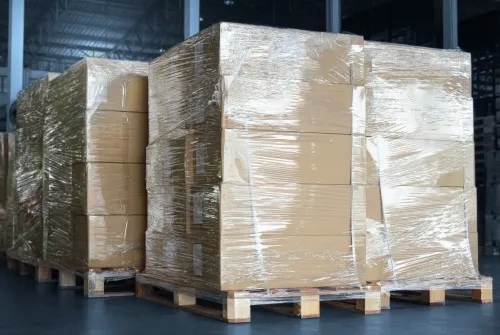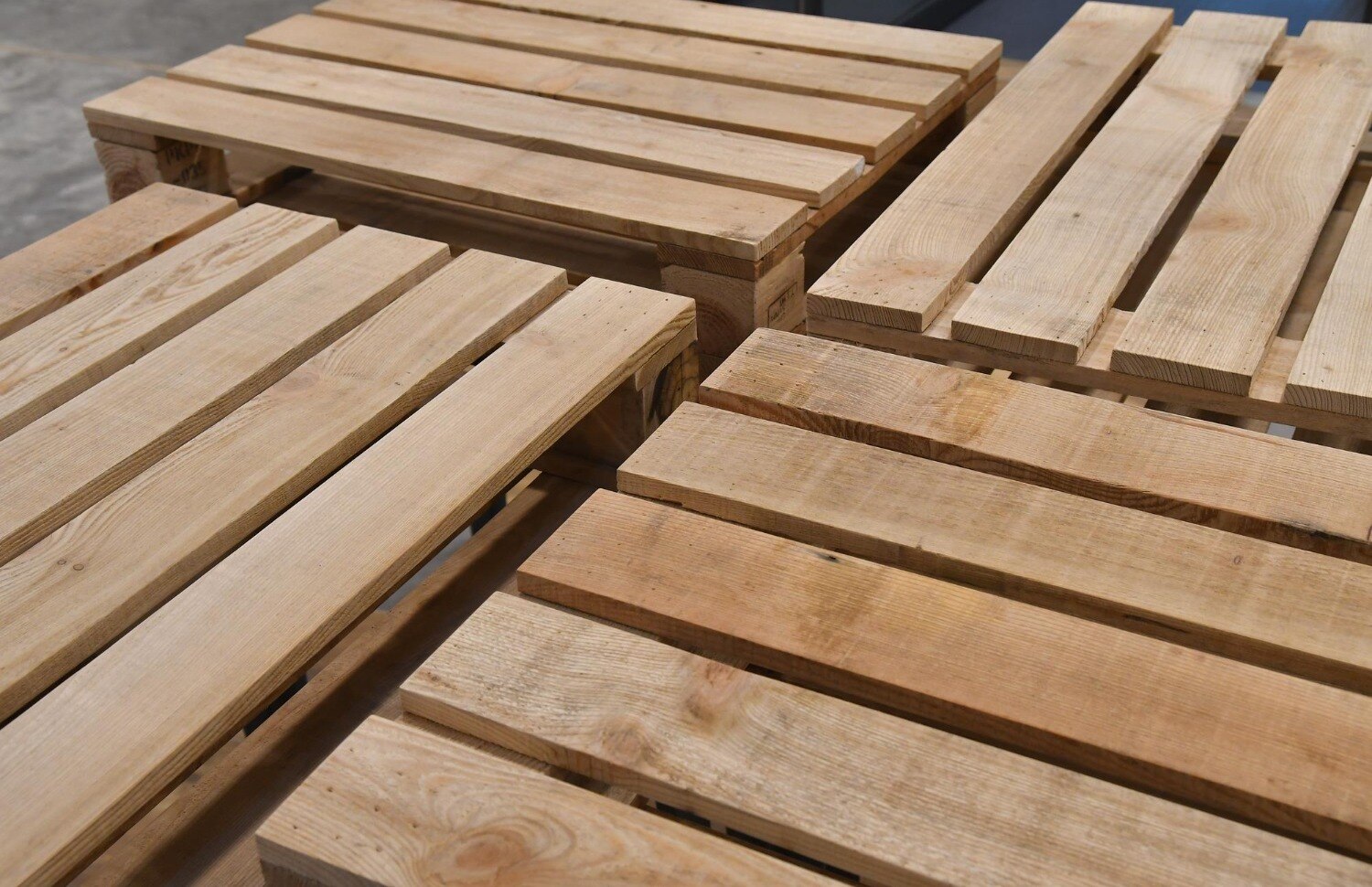
An export pallet needs more than a kiln stamp: the wood treatment, permanent IPPC mark, construction, load rating and cargo restraint must all withstand the destination country’s inspection and handling system. By the end, you will be able to verify ISPM 15 status, choose a suitable pallet design and prepare industrial cargo for shipment from Pune.
Key takeaways
- Look for a permanent ISPM 15 mark and request the treatment record.
- Accept HT treatment when wood reaches 56°C at its core for 30 minutes.
- Specify pallet length, width, entry openings, and safe working load.
- Use blocking, bracing, and rated straps to prevent cargo movement.
What proves that a wooden pallet is ISPM 15 heat treated?
The proof is a permanent ISPM 15 mark backed by a treatment record. Heat treated wooden pallets for export in Pune must reach a core temperature of at least 56°C for 30 continuous minutes; a kiln-air or surface reading does not prove that the centre of the thickest wood reached the target.
- Find the IPPC symbol, the grain-like wheat logo inside a rectangle.
- Check the two-letter country code beside it, such as IN for India.
- Check the unique producer or treatment-provider registration number.
- Check the treatment code HT, which identifies conventional heat treatment.
- Confirm that the mark is legible, permanent and applied to the pallet, not merely printed on an invoice or delivery note.
“Heat treated,” “export quality” and “fumigated” are not complete ISPM 15 evidence. Kiln drying can lower moisture content without achieving the required core-temperature schedule. The mark proves treatment by an authorized provider; it does not prove pallet strength, load capacity or sound construction.
Do not assume HT means bark-free. ISPM 15 permits bark within defined limits: pieces narrower than 3 cm can remain, while wider pieces must satisfy the standard’s bark-area limit. Specify bark-free wood or the permitted bark limit in your order.
For ISPM fifteen pallets in Pune, retain the treatment record, pallet quantity, batch reference or treatment date, and photographs of the mark for high-value cargo.
Which export shipments require treatment, and when is HT accepted?
A wooden pallet for overseas shipping falls under ISPM 15 when it contains solid wood thicker than 6 mm. That includes pallets, skids, crates, bearers, spacers and loose dunnage used to support or protect cargo.
Treatment codes do not mean the same thing:
| Treatment code | Meaning | Acceptance point |
|---|---|---|
| HT | Conventional heat treatment | Wood reaches a 56°C core temperature for 30 continuous minutes |
| MB | Methyl bromide fumigation | A separate treatment method with its own approval and restrictions |
| No code | No treatment evidence | Do not assume acceptance from an invoice saying “export quality” |
HT is accepted only when the destination permits it and the packaging carries an authorized ISPM 15 mark. An MB requirement cannot be replaced with HT by assumption, and an HT mark does not prove that MB rules have been met.
ISPM 15 does not cover packaging made entirely from plywood, oriented strand board, particle board or fibreboard. It also excludes wood components 6 mm thick or less because processing or thinness removes the pest risk addressed by the standard.
Before dispatch, check:
- The importing country’s plant-quarantine authority
- The importer’s written packaging instructions
- The carrier’s rules
- Requirements for bark, pest freedom, documents, inspection and accepted treatments
A valid mark can still become a shipment problem after repair. Untreated solid-wood boards, blocks, stringers or replacement dunnage introduce untreated material, so repair or remanufacture must follow the applicable treatment and marking procedure. Do not rely on the original pallet mark after an uncontrolled repair.
How should you specify pallet size, entry and load capacity?
Specify the pallet from the cargo and route, not from ISPM 15: the standard sets no universal size or safe working load. For export pallets for industrial cargo, measure the cargo footprint, then check container stowage, truck-bed width, forklift pockets, pallet-truck access, warehouse-rack beams and destination handling equipment.
| Choice | What it means | Select it when |
|---|---|---|
| Two-way entry | Forks enter from two sides | Handling equipment approaches from a fixed direction |
| Four-way entry | Forks or pallet trucks enter from four sides | Loading points and destination equipment vary |
| Stringer construction | Continuous timber members support the deck | Long loads need aligned support |
| Block construction | Blocks support forks and deck members | Four-way access or racking compatibility matters |
| Reversible deck | Both faces can carry the load | You need either face to function as the top |
| Non-reversible deck | Top and bottom have different layouts | You need a defined load face and lower material use |
| Standard dimensions | Fits a known handling pattern | Your cargo matches available container and rack space |
| Custom dimensions | Built around the actual footprint | Machinery would overhang or waste deck area |
Ask the supplier to state whether capacity is static, dynamic or racking capacity, and relate it to:
- Cargo weight and centre of gravity
- Support spacing, deck-board layout, stringers or blocks
- Point loads, overhang and rack-beam positions
For oversized machinery, provide a drawing or load schedule showing feet, lifting points and bearing areas. Heat treated pallets in Pune still need a separate structural assessment: an IPPC mark proves treatment and authorization, not resistance to crushed boards, concentrated loads or transport forces.
How do you prepare and restrain industrial cargo on the pallet?
A compliant pallet does not make a stable transport unit. Centre the machinery over the deck, keep its centre of gravity low, and spread weight across several boards. Narrow feet need load-spreading plates; never place a heavy foot over an unsupported gap.
Protect sharp edges before tightening restraint, or straps will cut into cargo and lose tension.
| Method | Select when | Main control |
|---|---|---|
| Strapping | Heavy, rigid machinery and road or container transport | Use edge protection and tension without crushing boards |
| Stretch film | Light, clean, grouped parts needing dust protection | It cannot restrain a high-mass or top-heavy load alone |
| Corner boards | Boxed cargo or strap-sensitive surfaces | Fit them beneath every strap path |
| Blocking and bracing | Narrow feet, projecting parts or uneven centres of gravity | Transfer forces into stringers, blocks or reinforced members, not thin deck boards |
| Anti-slip material | Smooth steel, vibration-sensitive parts or wet handling routes | Combine it with positive restraint; friction alone is not enough |
For wooden pallets for overseas shipping, choose the restraint from cargo shape, surface, mass and transport mode. Export pallets for industrial cargo need a securing design that survives container handling, road vibration and destination unloading.
- Confirm no cargo or pallet overhang, crushed boards, split members or loose fasteners.
- Check strap tension after handling and keep forklift entries clear.
- Add weather protection without hiding inspection points or creating a water trap.
- Reassess load-shift risk if the container is tilted, braked sharply or unloaded with different equipment.
What should you verify when buying heat-treated pallets in Pune?
Ask for the treatment provider’s authorization under India’s plant-quarantine system before ordering ISPM fifteen pallets in Pune. Then inspect the actual lot, not a sample photograph, for a legible permanent IPPC mark.
1. Check that every pallet carries the IPPC symbol, a two-letter country code, the registered producer or treatment-provider number, and the treatment code HT. Confirm that the code identifies the treatment provider, not merely the exporter or cargo owner.
2. Match the mark to a treatment record, invoice batch reference, treatment date or lot number. Retain the record, quantity, photographs and inspection notes for valuable shipments. A kiln certificate without a permanent mark, a stencil saying “fumigated” and a generic “export quality” statement do not prove ISPM 15 compliance.
3. Specify the pallet before production: length and width, two-way or four-way entry, deck design, cargo footprint, working-load basis, support spacing, bark tolerance, repair policy and destination country. The ISPM 15 mark proves treatment and authorization; it does not prove that the pallet supports your machinery.
4. Check the importing country, importer and carrier for extra rules on bark, documents, inspection or accepted treatments. For heat treated pallets in Pune, ask whether pallet selection and load restraint are being engineered together. Ramanand Pack Solution Private Limited, when handling both tasks, should retain the pallet drawing, securing method and dispatch inspection record.
Frequently asked questions
What proves that a wooden pallet is ISPM 15 heat treated?
A permanent ISPM 15 mark identifies the authorised treatment and country, while a treatment record supports the claim. The wood must reach a core temperature of 56°C for 30 continuous minutes; a kiln-air or surface reading does not prove the centre reached that temperature.
Which export shipments require treatment, and when is HT accepted?
Wood packaging made from solid wood, including pallets, used in international shipments generally needs an ISPM 15 mark. Heat treatment is accepted when the pallet bears the required permanent mark and the treatment meets the 56°C core-temperature requirement for 30 continuous minutes. Check the destination country's plant-health rules before shipping.
How should you specify pallet size, entry and load capacity?
State the pallet length and width in millimetres, deck height, fork and pallet-jack entry sides, clear entry height, and the cargo's gross weight. Specify safe working load for the storage and transport conditions, not only the maximum static load.
How do you prepare and restrain industrial cargo on the pallet?
Centre the load, keep its centre of gravity within the pallet footprint, and distribute weight across bearers. Add blocking, timber cleats, bracing, edge protection, and rated straps or chains so the cargo cannot slide, tip, or shift during lifting and transit.
What should you verify when buying heat-treated pallets in Pune?
Inspect the permanent ISPM 15 mark, confirm the treatment code and country identifier, request the treatment record, and check that the pallet is dry, structurally sound, and free from active infestation. Match its dimensions, entry openings, and safe working load to the cargo and handling equipment.