Choose an export crate from the machine’s handling route, load path and exposure risks—not from weight or dimensions alone. By the end, you will be able to match the shipment to an enclosed crate, open crate, plywood case, skid with cover or another format, then check whether the design can restrain, protect and legally move the equipment.
Key takeaways
- Use enclosed crates for rain, sea spray, dust, impact, pilferage and stacking loads.
- Match crate access and construction to the route, handling method and exposure.
- Verify load paths, restraints, lifting points and centre of gravity before packing.
- Use treated timber or compliant plywood and confirm ISPM 15 marks before export.
Start with the route, machine and handling method
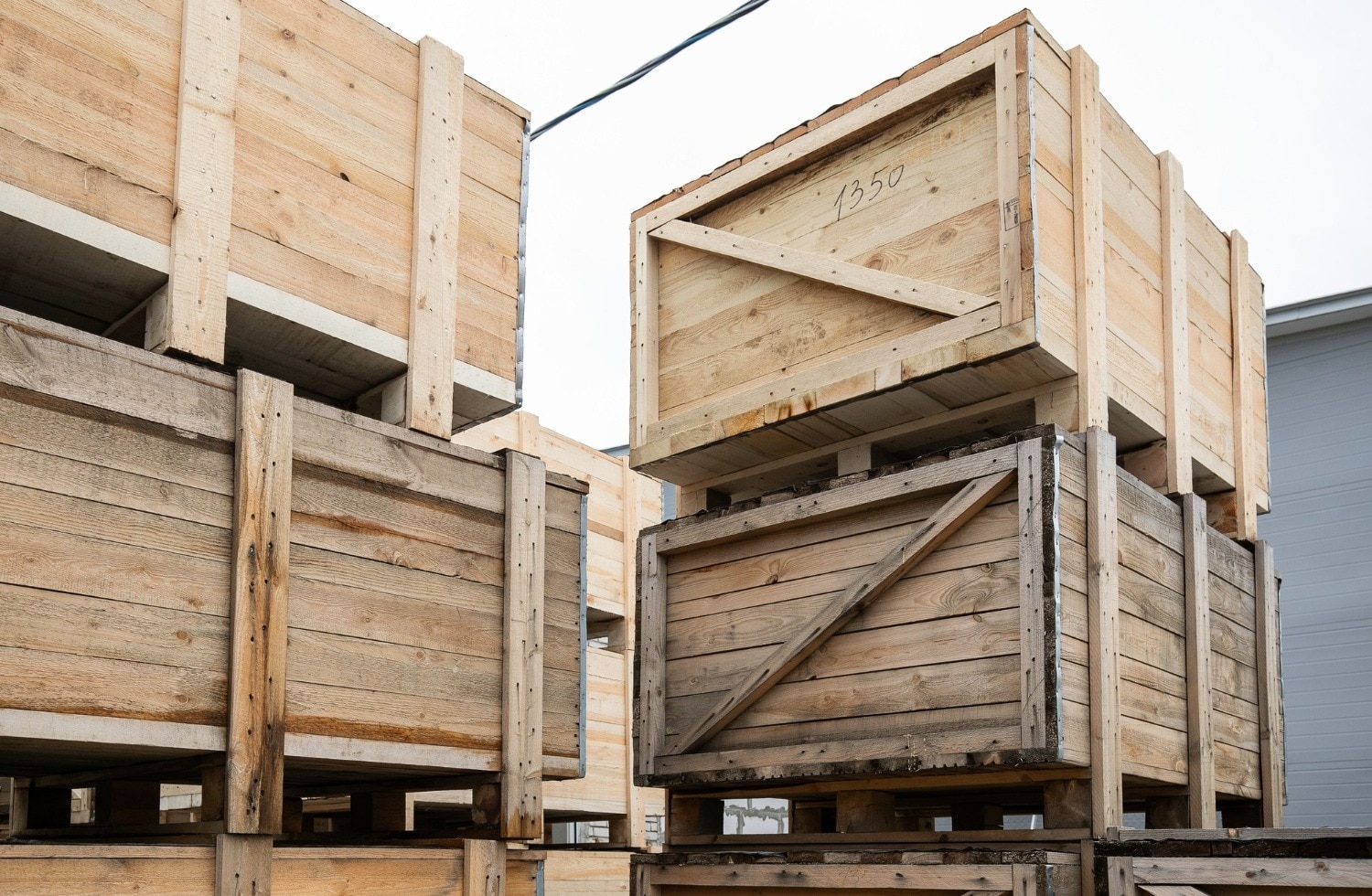
Use a fully enclosed wooden crate when the route exposes machinery to rain, sea spray, dust, impact, pilferage or stacking loads. It is the right starting point when the equipment needs physical protection throughout export handling, not merely during the ocean leg.
Export crate selection begins with the journey and handling plan, not the machine’s dimensions alone:
- Route: identify container, truck, port and warehouse transfers, including door clearances and possible stacking.
- Machine: record gross weight, dimensions, centre of gravity, fragile assemblies and corrosion sensitivity.
- Handling: confirm whether operators will use a forklift, crane sling or both, then check the equipment’s capacity and access.
- Base: plan a structural skid or base that carries the machine and transfers transport forces into the restraint system.
- Markings: reserve visible positions for gross weight, dimensions, orientation arrows, centre-of-gravity marks, sling points and forklift-entry sides.
Block, bolt, chock and brace the machine to the base. Do not rely on crate walls or sheathing to restrain the load unless an engineer has designed them for that job. A crate that hides lifting points or exceeds the planned handling equipment’s capacity is not suitable.
An open-slatted crate fits weather-resistant equipment when ventilation, inspection access or visibility matters more than enclosure. For unusually light, oversized, temperature-sensitive or shock-sensitive cargo, compare other packaging formats before deciding when to use export wooden crates.
Match the crate format to the exposure and access required
Rain, sea spray, dust, impact and pilferage call for a fully enclosed crate; an open format fits only equipment that can tolerate those exposures.
| Format | Select it when | Reject it when |
|---|---|---|
| Fully enclosed wooden crate | The route includes outdoor storage, sea freight, stacking or rough handling; the machine needs physical and visual protection. | Operators need frequent inspection or the equipment requires continuous ventilation. |
| Open-slatted crate | The machine is weather-resistant, ventilation matters, and handlers need clear visibility or easy access. | The cargo is corrosion-sensitive, fragile, or exposed to rain, spray, dust or theft. |
| Plywood case | The shipment needs an enclosed, smooth-sided package with good dimensional stability, clean internal surfaces and efficient panel strength. | Heavy point loads, poor nail-holding conditions or major structural restraint would be transferred into the panels. |
| Skid with cover | The machine needs a strong base, forklift access and overhead protection, while side access or oversized dimensions rule out full enclosure. | Side impact, pilferage, rain or stacked cargo threatens exposed machinery. |
Wooden crates for export machinery should place the machine on a structural skid or base. Blocking, bolting, chocks and braces must transfer transport forces into that base; do not rely on crate walls as restraints unless an engineer has designed them for that load.
For machinery export crates, check container-door clearance, forklift pockets, crane lifting points, centre of gravity and floor loading before choosing the format. A fully enclosed package that cannot be lifted or removed through the receiving facility’s access route is the wrong package.
Check the load path, restraint system and lifting details before packing
A crate that fits the machine can still fail if its load path ends at the sheathing. Before packing, trace every transport force from the machine through its mounts, skid, blocking and fasteners into the base, then confirm the base transfers those forces into the crate and handling equipment.
1. Record the machine’s gross weight, centre of gravity, lifting points, foot spacing and fragile projections. Compare these with container or truck door clearances, stacking height, allowable floor loading and the planned fork-truck or crane route.
2. Secure the machine to a structural skid or base. Use engineered bolting, chocking, blocking and bracing to resist longitudinal, lateral and vertical movement; do not rely on crate walls or panels as the primary restraint.
3. Check the load-bearing area beneath feet, casters and narrow skids. Add bearers or spreader members when concentrated loads could crush timber, deform a container floor or exceed a lifting point’s capacity.
4. Inspect fork pockets, sling beams, lifting lugs and access openings for clear, marked engagement. Keep lifting forces out of thin sheathing, and verify that the loaded centre of gravity will not make the crate tilt during a lift.
5. Define the inspection after delivery. Shock, tilt and humidity indicators record handling conditions, but they neither restrain the machine nor prove damage; link their readings to a documented examination of alignment, mounts and exposed components.
Good export crate selection therefore follows the load path, not the machine’s outline alone. The same checks distinguish reliable machinery export crates from boxes that look strong but shift, crush or twist during handling.
Choose solid timber or plywood, then verify ISPM 15 compliance
A solid-timber crate suits heavy machinery that needs strong nail-holding, robust blocking, and impact resistance. Choose a plywood export case when lower weight, cleaner internal surfaces, dimensional stability, and better protection from rain or dust matter more than direct nailing into the panels.
| Option | Strengths | Choose it when |
|---|---|---|
| Solid timber crate | Strong nail-holding and easy attachment of blocking, cleats, and braces | The machine is heavy, the restraint system needs substantial timber members, or handling impacts are likely |
| Plywood export case | Stable panels with fewer gaps and a smoother barrier against weather and dust | The cargo needs enclosure, surface protection, lower panel movement, or reduced exposure through joints |
| Hybrid construction | Timber base, posts, and restraint members with plywood sheathing | The machine needs structural timber for load transfer but enclosed panel protection |
ISPM 15 applies to raw solid wood used in wooden crates for export machinery, including the structural base, runners, skids, blocking, chocks, braces, battens, and loose dunnage. Plywood, oriented strand board, and fiberboard are processed wood and are normally exempt, but adding exempt panels does not exempt solid-wood components in the same package.
Check the crate before dispatch:
- Confirm every regulated solid-wood component received approved treatment, such as heat treatment, and carries a legible ISPM 15 mark with the IPPC symbol, country code, producer code, and treatment code.
- Keep the mark visible after strapping and loading; do not cover or alter it.
- Verify the destination’s current enforcement rules. Authorities can refuse, re-export, treat, or destroy noncompliant packaging.
- Remember that the mark proves treatment, not crate strength, restraint, lifting safety, or moisture protection.
Build moisture and corrosion protection around the route
Protect machinery for the route’s humidity and handling profile, not simply by sealing it inside wood. For sea freight or monsoon routes, use a fully enclosed crate against rain, sea spray, dust, impact and pilferage; an open crate is suitable only when the equipment is weather-resistant and inspection or ventilation matters more than enclosure.
Choose the crate format by exposure and access:
- Use a fully enclosed wooden crate with a properly sealed vapor-barrier film for prolonged ocean transit or repeated outdoor handling.
- Use an open-slatted crate when customs inspection, heat dissipation or visual checks are essential and the machine does not need a sealed moisture barrier.
- Use a skid with a cover when the machine needs strong base restraint and overhead protection but not full enclosure.
- Reject a standard wooden crate for oversized cargo requiring open access or equipment needing engineered shock, vibration or temperature control.
A sealed crate is not a dry crate. Clean and dry the machine first, removing coolant, wash water, salts and fingerprints; then coordinate vapor-barrier film, desiccant and, where suitable, VCI paper or oil. Calculate desiccant from enclosed air volume, film permeability, transit duration and expected humidity—not machine weight.
Ordinary plastic around an open crate can trap condensation without controlling it.
For specialized transport, secure the machine to a structural skid with blocking, bolting, chocking and bracing; do not rely on crate walls. When planning wooden export packaging, Ramanand Pack Solution Private Limited should record the route, film specification, desiccant calculation and restraint points.
This makes when to use export wooden crates a documented decision rather than a guess.
Frequently asked questions
When should you use a fully enclosed wooden crate for machinery?
Use one when the route exposes machinery to rain, sea spray, dust, impact, pilferage or stacking loads.
How do you select the right export crate format?
Match the crate’s enclosure, access panels and construction to the route exposure, handling method and access required.
What should you check before packing machinery in a crate?
Check the load path, restraint system, lifting points, centre of gravity and handling clearances.
How do you verify ISPM 15 compliance for an export crate?
Use compliant treated timber or plywood and verify the authorised ISPM 15 mark on solid-wood components.